WELCOME TO OUR WEBSITE

Main Coastal Ecosystems In Ambon
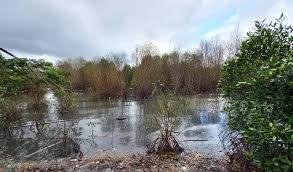
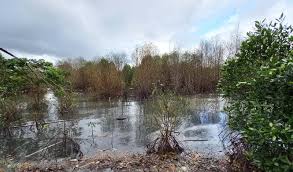
Mangrove forests
Mangrove forests, also called mangrove swamps, mangrove thickets or mangals, are productive wetlands that occur in coastal intertidal zones.[1][2] Mangrove forests grow mainly at tropical and subtropical latitudes because mangroves cannot withstand freezing temperatures. There are about 80 different species of mangroves, all of which grow in areas with low-oxygen soil, where slow-moving waters allow fine sediments to accumulate.Many mangrove forests can be recognised by their dense tangle of prop roots that make the trees appear to be standing on stilts above the water. This tangle of roots allows the trees to handle the daily rise and fall of tides, which means that most mangroves get flooded at least twice per day. The roots slow the movement of tidal waters, causing sediments to settle out of the water and build up the muddy bottom. Mangrove forests stabilise the coastline, reducing erosion from storm surges, currents, waves, and tides. The intricate root system of mangroves also makes these forests attractive to fish and other organisms seeking food and shelter from predators.
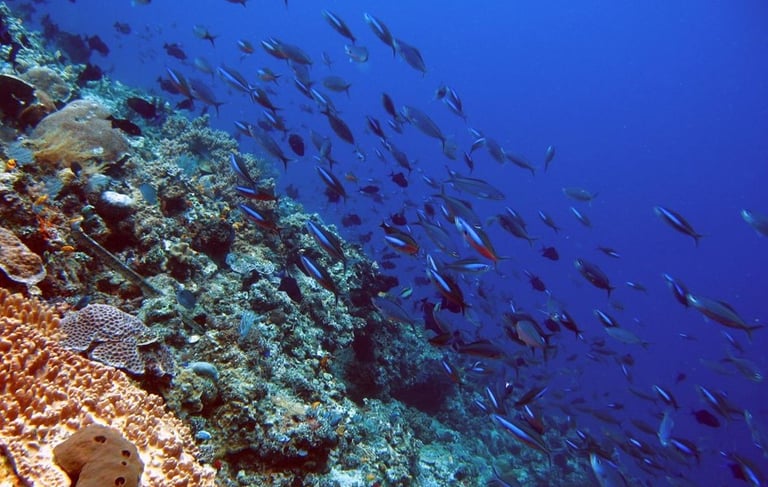
Coral reefs are a unique ecosystem found in coastal waters in tropical regions. There are two specific explanations for the terms "reef" and "coral," which are not a single unit, but rather a combination of the words "reef" and "karak," which will be explained in the following discussion.
Corals are tiny individuals called polyps. Each polyp resembles a water-filled sac with a ring of tentacles surrounding its mouth, resembling a small anemone. Polyps within a colony are connected by living tissue and can share food. A coral reef, on the other hand, is a structure on the seafloor made up of calcium carbonate deposits produced primarily by corals. Corals are invertebrates belonging to the phylum Coelenterata (hollow animals) or Cnidaria.
Corals look like plants, but they are actually a collection of tiny animals called polyps. The first person to classify corals as animals was J.A. de Peysonell, a French biologist, in 1753. Scientifically, corals are classified as members of the phylum Cnidaria, class Anthozoa. Coral reefs are also a collection of coral communities (animals) that live on the seabed, composed of limestone (CaCO3), and are strong enough to withstand the force of ocean waves. Reefs are formed from massive deposits of calcium carbonate produced by reef-building organisms (hermatophytic corals) from the phylum Cnidaria, order Sclerectinia, which live in symbiosis with zooxanthellae algae and a small number of calcareous algae and other organisms that secrete calcium carbonate.
seagrass
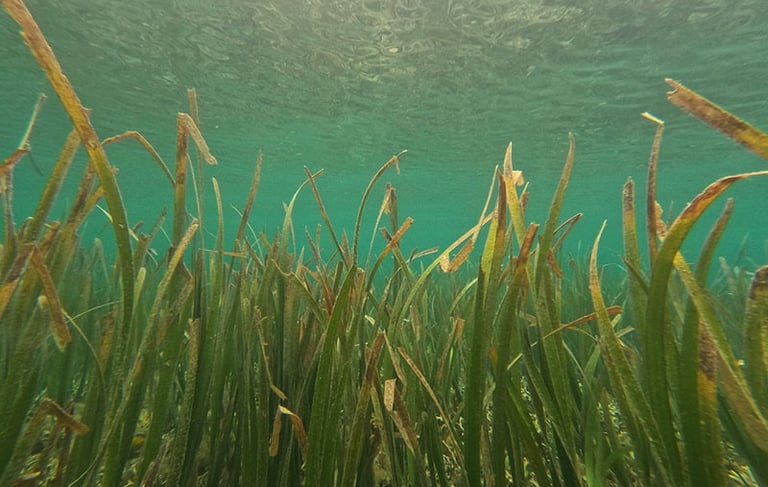
Seagrass is a flowering plant (Angiospermae) that can grow well in shallow marine environments. All seagrasses are one-seed plants (monocots) which have roots, rhizomes (rhizomes), leaves, flowers and fruit just like vascular plants that grow on land. So it is very different from seaweed (algae). Seagrass grows in clusters and usually occupies shallow warm sea waters and connects the mangrove ecosystem with coral reefs. Areas of sea water where seagrass grows are called seagrass meadows, and can become a unique ecosystem of its own.